
GUM GRAFTING · PERIODONTICS
Rebuild protection
around exposed roots.
Gum recession can cause sensitivity, make teeth look longer and leave roots vulnerable. Dr. Hosan Park is a Columbia-trained, US board-certified periodontist and certified Pinhole® Surgical Technique provider.
Signs of gum recession.
Receded gum tissue does not predictably grow back on its own. Early diagnosis can identify the cause and determine whether monitoring, habit change, periodontal treatment or grafting is appropriate.
Cold sensitivity
Exposed root surfaces are not protected by enamel and can respond sharply to temperature.
Teeth look longer
A receding gum line exposes more of the root and changes the apparent tooth proportion.
Discomfort when brushing
Thin or inflamed tissue can be more vulnerable to repeated brushing trauma.
Before or after orthodontics or implants
Thin tissue and inadequate attached gum may require reinforcement around selected teeth or implants.
How treatment is planned.
Gum grafting uses tissue from the palate or an appropriate substitute to increase tissue thickness, create a more stable gum zone or cover an exposed root. The technique is chosen around the defect, tissue phenotype, esthetic goal and predictability—not simply by patient preference.
Periodontal examination
We measure recession, tissue thickness and attachment, and assess brushing trauma, inflammation, tooth position and bite.
Control the cause
Inflammation and contributing habits are addressed first so the graft has a healthier environment.
Grafting procedure
Free gingival grafting, connective tissue grafting, Pinhole treatment or a substitute material may be selected when indicated.
Healing and maintenance
The graft is monitored through early healing, followed by brushing guidance and long-term periodontal review.
Gum grafting methods.
| METHOD | FEATURE | COMMON PURPOSE |
|---|---|---|
| Free gingival graft (FGG) | Surface tissue from the palate increases the band of firm, keratinized gum. | Limited attached tissue around molars or implants. |
| Connective tissue graft (CTG) | Connective tissue from beneath the palate is placed under the recipient tissue for root coverage and thickness. | Visible recession, especially in the esthetic zone. |
| Pinhole® technique | Selected recession defects are repositioned through a small access point without a conventional graft incision. | Multiple adjacent recession sites when anatomy is suitable. |
| Substitute material | A biomaterial may reduce or avoid a second surgical donor site. | Broad sites or cases where donor tissue is limited. |

Trained by the technique’s originator.
Dr. Park completed direct training with Dr. John Chao, creator of the Chao Pinhole® Surgical Technique. Pinhole treatment is not appropriate for every recession defect; when anatomy favors another graft, that option is recommended instead.
Cases treated by our doctors.
The upper image shows before treatment and the lower image shows after treatment.
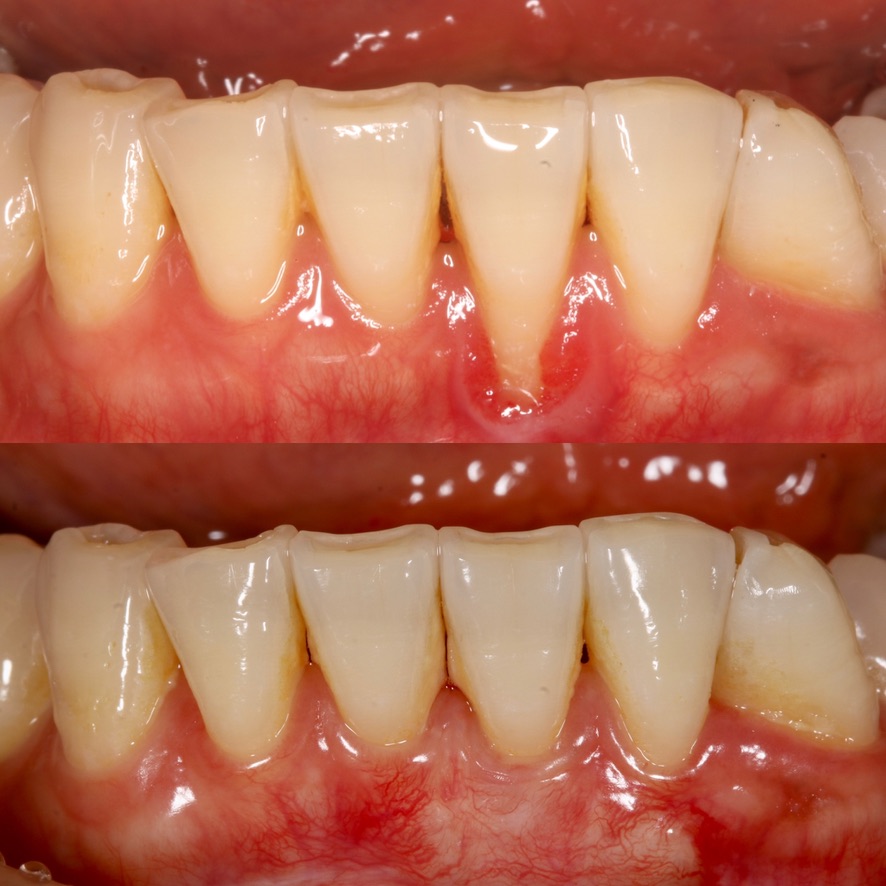


These clinical photographs show actual cases treated by Hana Dental Clinic’s doctors and are published with consent. Results vary by individual condition, and every procedure carries potential risks and side effects.
Gum grafting questions
Is gum grafting painful?
The procedure is performed with local anesthesia. Postoperative discomfort varies by technique and whether tissue is taken from the palate. Most early soreness improves over one to two weeks.
What is the Pinhole Surgical Technique?
Pinhole treatment repositions selected receded gum tissue through a small access point rather than a conventional graft incision. Suitability depends on tissue quality, defect anatomy and periodontal health.
Can receded gums grow back naturally?
Established recession does not predictably reverse on its own. Early intervention may stop progression by correcting inflammation or brushing trauma; grafting may be considered when coverage or tissue reinforcement is needed.
Do implants ever need gum grafting?
Firm, adequately thick tissue can make implants easier to clean and more stable. If tissue is insufficient, grafting may be recommended before, during or after implant treatment.
Can you assess recession from photos before I travel?
Photos can support a preliminary review, but probing measurements, tissue thickness and tooth position must be assessed in person before a definitive plan.
Sensitivity or recession deserves a precise diagnosis.
Send clear photos for an initial review, then receive a treatment plan after a full periodontal examination.